Yasukawa Lab./ Kyushu Institute of technology
About Yasukawa Laboratory
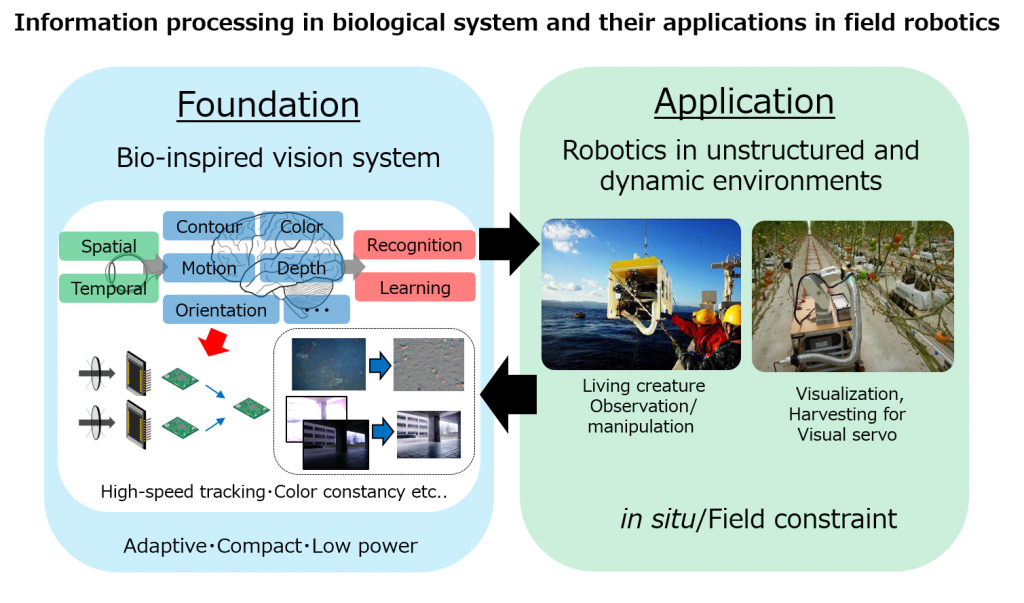
Yasukawa Laboratory studies the computational principles of biological sensory systems and reconstructs these principles through mathematical models, electronic hardware, embedded systems, and robotics.
Our primary interest is not simply to apply existing artificial intelligence techniques to engineering problems. Instead, we investigate how biological sensory systems efficiently extract information from the environment, how sensory processing interacts with the body and its movements, and how these mechanisms can inspire new sensing and control systems.
Our research can be summarized as:
Understand biological sensory systems, reconstruct them in hardware, and evaluate them through embodied robotic experiments.
We mainly study biological vision, while related sensory and sensorimotor systems may also be considered.
Our Research Philosophy
A typical research project in our laboratory follows the process below.
1. Start from a biological function or mechanism
We first identify a specific sensory function that should be understood.
Examples include:
- Information processing in the retina and early visual pathways
- Spatial and temporal adaptation
- Neural coding based on spike timing
- Target detection and motion processing
- Active vision and eye movements
- Interaction between sensory processing and body movement
- Event-driven sensory processing
The starting point should be a concrete scientific question about biological sensing or sensorimotor behavior.
2. Develop a mathematical or computational model
We then formulate a model that can explain the biological function.
The objective is not necessarily to reproduce every biological detail. Instead, we seek the essential structures, dynamics, and computational principles that generate the observed function.
Models may be developed using:
- Dynamical systems
- Neural circuit models
- Spiking neuron models
- Image and signal processing
- Computational neuroscience
- Simulation-based analysis
3. Reconstruct the model in real-time hardware
The proposed model is implemented as an actual sensing or processing system.
Depending on the research question, we use:
- FPGA-based digital circuits
- Embedded processors
- Event-based vision sensors
- Image sensors
- Spiking neural processing
- Real-time signal-processing circuits
- Hardware–software co-design
Hardware implementation is not merely an optimization step. It is often used as a constructive method for examining whether the proposed model can operate in real time under physical and computational constraints.
4. Evaluate the model through embodied systems
Whenever possible, the model or hardware is connected to a robot, sensor system, or physical experimental platform.
We examine how sensory processing works when the system interacts with the environment through movement.
Possible test platforms include:
- Active vision systems
- Eye-movement mechanisms
- Mobile robots
- Agricultural robots
- Underwater robots
- Field sensing systems
In our laboratory, robotics is both an application domain and an experimental method for investigating sensory intelligence.
Main Research Areas
Bio-inspired Visual Information Processing
We study information-processing mechanisms found in biological visual systems, particularly the retina and early visual pathways.
Research topics may include:
- Retinal neural circuits
- Center–surround processing
- Spatially non-uniform visual processing
- Light and contrast adaptation
- Sustained and transient visual responses
- Spike-based visual coding
- Target and motion detection
- Predictive visual responses
- Information compression in early visual pathways
The aim is to identify computational principles that cannot be adequately explained only by conventional image processing or large-scale data-driven learning.
Neuromorphic Sensory Systems
We develop sensing and processing systems inspired by the structures and temporal dynamics of biological nervous systems.
Research topics may include:
- Neural emulators implemented on FPGA
- Event-driven sensing and computation
- Spiking neural circuits
- Real-time sensory information processing
- Low-latency and low-power visual processing
- Interactions between sensors, neural models, and physical systems
Our use of the term “neuromorphic” does not simply mean running a neural network on low-power hardware. A project should be connected to a biological structure, neural response, sensory function, or sensorimotor mechanism.
Active Vision and Sensorimotor Systems
Biological vision is not a passive process. Animals actively move their eyes, heads, and bodies to acquire useful sensory information.
We therefore investigate:
- Fixational eye movements
- Eye–head coordination
- Active sensing strategies
- Sensory consequences of body movement
- Closed-loop visual control
- Interaction between visual coding and motor behavior
We are particularly interested in models that change their sensory processing according to movement, behavioral state, or environmental conditions.
Event-Based Vision
Event-based cameras provide asynchronous visual signals that differ fundamentally from conventional image frames.
We study event-based vision in connection with:
- Biological temporal processing
- Spatiotemporal filtering
- Motion and target detection
- Event representation and compression
- FPGA and embedded implementation
- Real-time object tracking
- Closed-loop robotic perception
A project should normally investigate the computational or sensing principles of event-driven processing, rather than only applying a standard machine-learning model to event-camera datasets.
Robot Vision for Field Environments
We also develop sensing and robot-vision technologies for challenging real-world environments, including agricultural and underwater fields.
Examples include:
- Vision for crop observation and harvesting
- Visual exploration by agricultural robots
- Underwater image sensing
- Vision in turbid water
- Synchronized projector–camera systems
- Visual tracking and docking
- Real-time embedded perception
These field-robotics projects are closely connected to sensing, perception, and embodied intelligence. Our laboratory is not primarily focused on general mechanical design, path planning, or conventional robot control without a significant sensory-processing component.
Technologies Are Tools, Not Research Topics
We use technologies such as AI, machine learning, deep learning, IoT, ROS, embedded processors, and FPGA.
However, the use of one of these technologies alone does not define a suitable research topic.
For example, the following themes by themselves are generally outside the central scope of our laboratory:
- General IoT monitoring systems
- Mobile or web application development
- Cloud-based sensor-data platforms
- Standard deep-learning classification
- Generic explainable AI
- Healthcare-data prediction
- Model compression as the primary research objective
- Deployment of existing AI models on ESP32-class devices
- Benchmarking existing machine-learning methods without a sensory-science question
- General autonomous robotics without a sensory or sensorimotor research question
Such technologies may be used as part of a project, but the project must be clearly connected to biological sensory processing, neuromorphic engineering, active sensing, or embodied robot perception.
Examples of Suitable Research Questions
Suitable research questions may include:
- How can a particular retinal neural circuit explain a visual response observed in biological experiments?
- Which computational function emerges from the spatial and temporal structure of an early visual pathway?
- Can an FPGA-based neural emulator reproduce the response properties of a biological sensory system?
- How do eye or body movements change the information encoded by sensory neurons?
- Can active movement improve visual sensing beyond the limitations of a static image sensor?
- What advantages do event-driven representations provide for real-time embodied perception?
- How can a biologically grounded visual model be evaluated through a closed-loop robotic experiment?
- Can a sensory mechanism identified in biology provide a new design principle for field-robot perception?
A suitable proposal should identify a specific mechanism, hypothesis, or sensory function. Merely combining several popular technologies is not sufficient.
Who May Be a Good Fit?
We welcome students from a variety of academic backgrounds, including:
- Electrical and electronic engineering
- Computer engineering
- Information science
- Robotics
- Mechatronics
- Control engineering
- Signal and image processing
- Computational neuroscience
Previous experience in neuroscience is not mandatory. However, students must be willing to study biological sensory systems and formulate research questions based on biological functions or experimental findings.
Previous FPGA or circuit-design experience is also not mandatory. Students who conduct hardware-oriented research will be expected to learn digital circuit design, real-time implementation, and experimental evaluation.
A good candidate should be interested in crossing the boundaries between neuroscience, electrical engineering, information science, and robotics.
What We Expect from Master’s and Doctoral Students
Students are expected to:
- Identify a clear research question rather than only selecting a technology
- Explain why the problem is scientifically or engineeringly important
- Read research papers critically
- Distinguish biological mechanisms, computational models, hardware implementations, and applications
- Design experiments that can support or reject a hypothesis
- Implement and evaluate systems independently
- Discuss unsuccessful results and limitations honestly
- Communicate progress through presentations and academic writing
We strongly encourage students who are interested in continuing to a doctoral program and developing an original interdisciplinary research field.
Before Contacting Us
Before sending an inquiry, please review our recent publications and research projects.
In your first email, please briefly answer the following questions:
- Which specific research topic or publication from our laboratory interested you?
- Which biological sensory mechanism or sensorimotor function would you like to investigate?
- What scientific question would you like to answer?
- How would you connect biological understanding, modeling, hardware or software implementation, and experimental evaluation?
- Which of your previous skills would be useful for the proposed research?
- Which new fields or technologies would you need to learn?
Please do not send only a generic research proposal on AI, IoT, embedded systems, or robotics.
A proposal prepared for another laboratory and modified only by adding our laboratory name or research keywords will not be considered a strong match.